
Sources for Elizabeth Previous Residents
An Elizabeth address history changes source by era. Start with the present Elizabeth parcel identifiers, then move to the Union County Clerk’s title records and older Elizabeth directory material. The online land system is useful for newer transfers, while the record room reaches further back. Directories and criss-cross books can supply a dated household listing. Census schedules add family context, and Elizabeth Sanborn maps explain the building and street setting rather than naming a household.
| Source | Years It Covers | Where Held | What It Shows |
|---|---|---|---|
| County land record room | 1857-present | Union County Clerk in Elizabeth | Recorded instruments, parties, and legal descriptions |
| Online land index | June 1, 1977-current | Union County Public Land Records for Elizabeth | Name, date, and document-type index; image access varies |
| Elizabeth directories | 1879-80 onward, selected runs through 1926 | State Library and local research collections | Names, occupations, and addresses in identified years |
| Elizabeth criss-cross books | 1954 and 1956-59 | Library of Congress | Address-to-occupant listings for identified years |
| Elizabeth Sanborn map selection | 1889, 1903, 1918, 1920, 1922, 1923 | Princeton and Library of Congress | Footprint, building use, material, and neighborhood context |
| Federal census | Public through 1950 under the 72-year rule | National Archives and approved repositories | Household relationships, age, birthplace, and occupation |
These sources are not a complete roster of previous residents. Elizabeth building-permit historical coverage has no verified online cutoff. For a dated construction question, ask the Construction Bureau or use a narrow city OPRA request for a street address, block and lot, and date range.
Note: An Elizabeth source establishes only the fact it records, so retain its date and avoid filling a gap with an assumption.
Elizabeth Tax Records Start the Trail
Begin with the current Elizabeth tax record, not the street name alone. The Elizabeth Tax Assessor maintains owner, tax mailing address, location, year built, lot size, and structural characteristics. For an online query, the state assessment process uses County UNION and District ELIZABETH, with Location, Owner Name, Block, Lot, and Qualifier as recorded criteria. Save the Elizabeth list year as well as the situs address, owner, block, lot, and qualifier.
A tax mailing address is a useful lead but is not evidence that its recipient lived at the Elizabeth parcel. It may belong to a trust, business, bank, attorney, estate, or an owner elsewhere. A transfer after the annual list is certified can also appear later than the recorded deed. Use the Elizabeth block and lot to connect the tax result to the map and title trail.
Note: Retain the Elizabeth assessment list year with each result, because a later deed transfer may not yet appear in a certified tax list.
Elizabeth Deed Records, Backward
The Union County Clerk name search is party-based rather than address-based. Search the current tax owner as Grantee, choose Deed, and use a date range that fits the likely purchase. The result should be checked for instrument number, recorded date, grantor, grantee, page count, and legal description. A matching Elizabeth block or lot helps distinguish the right parcel when names repeat.
- Record the Elizabeth situs, tax owner, mailing address if shown, block, lot, qualifier, and list year.
- Search the Elizabeth tax owner as Grantee in the Clerk’s name index, selecting Deed and a useful date range.
- Open or request the Elizabeth result, then save its instrument number, date, grantor, grantee, book or page reference, and legal description.
- Search that grantor as an earlier Grantee to locate the prior purchase of the same Elizabeth parcel.
- Repeat the party-to-party step, testing the Elizabeth legal description and block or lot each time.
- Move to the Clerk’s older books, indexes, or microfilm when the trail precedes online coverage.
- Grantor
- The party transferring an interest in an Elizabeth recorded instrument, commonly the seller in a deed.
- Grantee
- The party receiving an interest in the Elizabeth instrument, commonly the buyer in a deed.
- Chain of title
- An Elizabeth linked sequence of recorded transfers for the same legal parcel, traced from one owner to the prior one.
- Legal description
- The Elizabeth parcel description in a deed, often using block and lot or survey language, which is more durable than a changing street label.
An Elizabeth deed chain establishes title movement. It does not establish that every named owner lived at the property, and it does not name every member of a past household. Use the chain to organize evidence about previous residents, not to infer a household from title alone.
Elizabeth Records Beyond the Online Index
The Union County Public Land Records portal begins its online index on June 1, 1977. The County Clerk record room retains Elizabeth land transactions from 1857 to the present. Images for documents before January 1986 are still being imaged, so an older Elizabeth index result may exist without an image. Keep the instrument number and book or page reference, then ask for the available book, microfilm, copy, or imaging help rather than treating a missing online image as a missing record.
The County Clerk recording office is at 2 Broad Street in Elizabeth. Listed Elizabeth recording-office hours are Monday through Friday, 8:30 a.m. to 4:30 p.m.; over-the-counter recording ends at 3:30 p.m. Certified copies can be ordered through the portal or by mail. The published price is $8 for the first page and $2 for each additional page. Call 908-527-4787 before a visit when an older volume or a specific copy route matters.
Elizabeth Legal Records Bridge Addresses
Elizabeth street numbers and names can change in form, but a deed’s legal description and the tax block or lot provide a more stable bridge. Compare the assessment record with Elizabeth tax maps, GIS parcel data, and the deed description before linking an old Elizabeth directory address to a modern parcel. A map boundary is approximate and is not a legal survey, yet it can help show whether a corner, alley, rear lot, or later lot split is involved.
No verified citywide Elizabeth street-renumbering year was found in the reviewed material. Treat that as an Elizabeth research gap. Test a suspected old and new number through historic maps, Sanborn index sheets, city ordinances, directory cross-references, and the recorded legal description instead of assuming that nearby numbers are equivalent.
Elizabeth Previous Residents in Directory Years
For who lived here before, directories add the household layer that a deed may not provide. The New Jersey State Library inventory identifies Elizabeth runs from 1879-80 through selected volumes in the 1920s, with a combined Elizabeth, Hillside, Roselle, and Roselle Park directory for 1924-26. The 1873 digitized directory also gives an earlier local pattern. Its “h,” “bds,” “wid,” “do,” and “cor” marks can preserve home, boarder, widow, repeated-address, and corner information in a few characters.
Use an Elizabeth address or surname for a known year, preserve the entry exactly, and then test nearby available volumes. Principal adults may appear while other occupants do not. The historical collections themselves, publishers, and reading keys are covered in the Elizabeth City Directory collections.
Elizabeth Public Library’s Local History Room offers appointments and paid remote research for focused address, obituary, and local-history questions. The room is at 11 S. Broad Street; requests may be sent to eplreference@elizpl.org or made with its research form. Supply the target years, the address, and any owner names already found so staff can identify a directory, clipping, or photograph lead efficiently.
Note: A directory name identifies a dated listing, while title and census records supply different Elizabeth address-history evidence.
Pair Elizabeth Directories With Census
Elizabeth directory years and census years answer different parts of the same address question. An Elizabeth directory is a local annual or periodic snapshot with a precise printed street clue. A census is less frequent but can describe relationships, ages, birthplaces, and occupations. Public federal schedules reach 1950 under the 72-year release rule. Pairing them avoids treating either source as a full, continuous record of past residents.
The Library of Congress identifies Elizabeth criss-cross books for 1954 and 1956-59. Use the exact Elizabeth historical street spelling and number in those address-order volumes, then compare the listed name to the closest census, directory, or deed point. A difference can reflect an Elizabeth move, a different listing date, a spelling variant, or an incomplete directory, not necessarily an error.
- Choose the directory or criss-cross year closest to the title event being researched.
- Record the full Elizabeth printed address, name, occupation, and abbreviations from that volume.
- Check the closest public census schedule for Elizabeth household relationships and age context.
- Compare each Elizabeth address against the block or lot from tax and title records.
- Use an obituary citation or probate file to test a move, death, or estate transition.
Elizabeth Records: Sanborn Map Context
Sanborn sheets can show why an Elizabeth address looks different across Elizabeth records. The Princeton Elizabeth Sanborn guide selects 1889, 1903, 1918, 1920, 1922, and 1923 map years; the Library of Congress offers a public-domain Elizabeth set for 1903 with 101 sheets. Use the Elizabeth index to locate a block, then compare a building footprint, material, stories, and nearby uses with the tax map and dated directory entry.
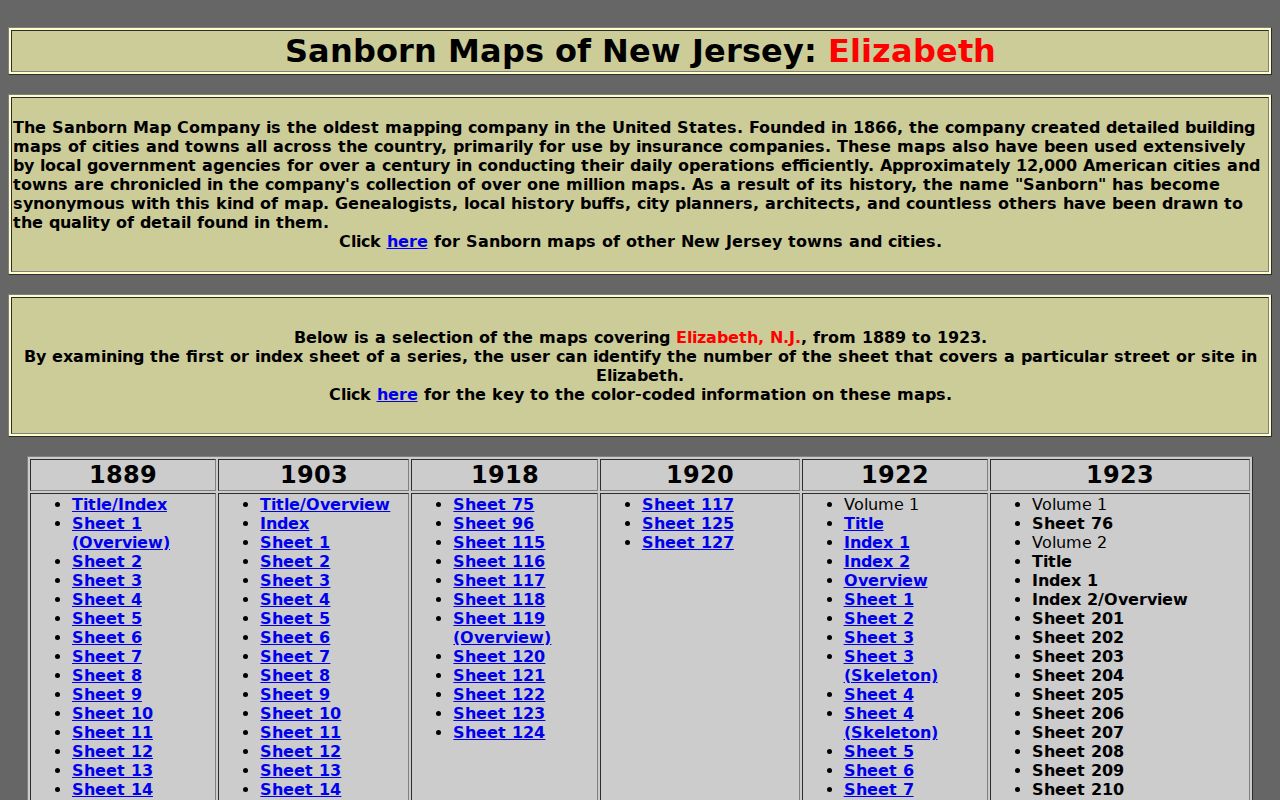
An Elizabeth Sanborn label documents the building and its surroundings, not its occupants. It is most useful when it confirms that an address, lot, or structure stayed in the same physical place while the people trail is reconstructed from separate dated records.
Elizabeth Probate Records as Endpoints
Past Elizabeth residents often leave the address trail through a death, an estate, or a move. Elizabeth Public Library’s genealogy vertical-file index can point to a dated obituary or article, and the Union County Surrogate keeps public original wills and probate-related files. An Elizabeth probate record may identify an executor, next of kin, and an estate address. Cross-check those details against a directory date and deed description before linking them to a particular Elizabeth parcel.
Lawful personal use. Elizabeth address history is appropriate for family history, estate research, and personal property curiosity. Do not use old-address findings to track, harass, or harm a living person.
The strongest former-household conclusion is dated and convergent: a directory places a person at the address, title or probate supports the property connection, and an obituary or census supplies independent context.